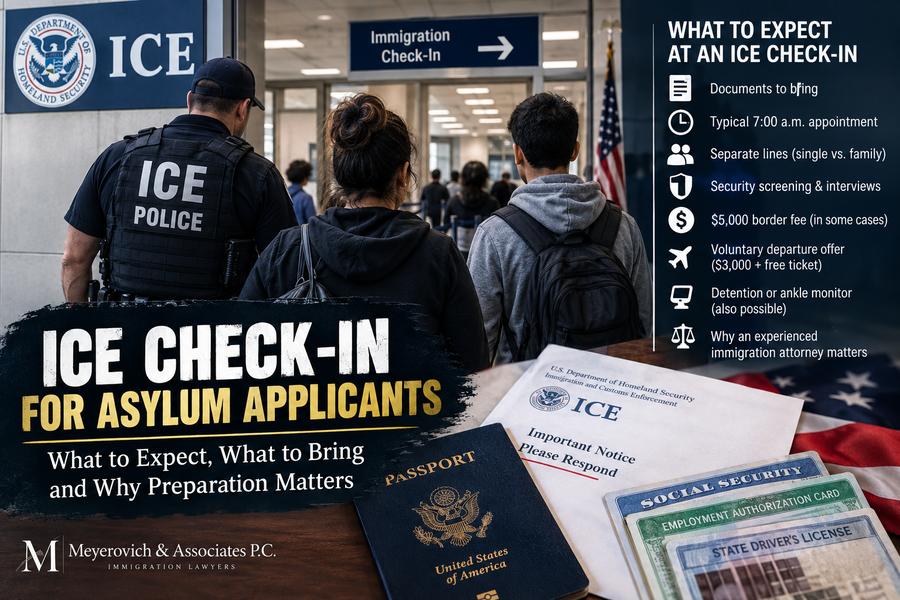
For many asylum applicants who entered the United States through the southern border, receiving a letter directing them to report to Immigration and Customs Enforcement has become another stage of an already complicated immigration process.
The appointment may look routine. The notice provides a date, an address, and often an early reporting time — many of the appointments we're seeing require people to arrive at approximately 7:00 a.m. What happens after the applicant walks through the door, however, can be anything but routine.
An ICE check-in can last for hours. Officers may review identity and immigration history, discuss the circumstances of the person's entry, impose additional reporting or electronic monitoring requirements, present documents for signature, discuss government fees or self-departure programs, and, depending on the person's circumstances, make decisions concerning continued release or detention. For an asylum applicant who has never experienced an ICE check-in, the environment itself can be intimidating. That's exactly why preparation matters.
The first ICE check-in often begins with a letter
Many asylum applicants who were processed and released after crossing the border later receive instructions requiring them to report personally to ICE. The first mistake is treating that notice like an optional appointment.
An ICE reporting requirement is separate from an immigration court hearing. Appearing in immigration court does not necessarily satisfy an ICE reporting obligation, and reporting to ICE does not replace an immigration court hearing. The agencies have different functions — ICE is part of the Department of Homeland Security, while immigration courts are administered by the Department of Justice's Executive Office for Immigration Review. An applicant should keep track of both systems and carefully review every notice received from either agency.
What should you bring to an ICE check-in?
The notice may instruct the applicant to bring identification documents. That sounds simple until you consider the reality of many border cases: a significant number of asylum applicants no longer have their passports because the original travel documents were taken into government custody when they were processed at the border.
If the passport is unavailable, the applicant shouldn't simply arrive empty-handed. Depending on the person's circumstances and the appointment notice, useful identification and supporting documents may include:
- Birth certificate with a certified English translation
- Employment Authorization Document
- Social Security card
- Driver's license or state identification
- Copies of relevant immigration documents
We also recommend clients have documentation showing their established life in the United States where appropriate — recent tax returns, proof of residence, employment documentation, and other records may be useful depending on the purpose of the appointment and the individual's immigration history. Original immigration notices should be organized before the appointment rather than carried in as an unmarked pile.
For someone with any criminal arrest history, preparation becomes considerably more important. An arrest doesn't necessarily mean a conviction, and an officer shouldn't have to guess how a criminal case ended. Certified or original court dispositions for arrests and criminal cases should be obtained in advance and reviewed with immigration counsel.
What happens when you arrive?
Procedures can vary by ICE office and by the individual case. No applicant should assume that another person's experience predicts exactly what will happen at his or her appointment.
At recent check-ins, applicants have encountered airport-style security screening and metal detectors before entering the secure area. Once inside, they may be separated according to how ICE is processing appointments that day. In our recent experience, individuals arriving alone and families were processed separately, then met with ICE personnel in a secure government environment.
The interview itself can be lengthy. A recent check-in involving our clients lasted more than five hours. Other appointments can consume much of the working day. Applicants should plan accordingly rather than expecting to report at 7:00 a.m. and leave shortly afterward.
The $5,000 border fee may be raised at the check-in
Some asylum applicants are surprised when ICE raises a fee connected with their manner of entry. Federal law created a fee of at least $5,000 for certain inadmissible noncitizens apprehended while entering the United States between ports of entry, with inflation adjustments provided by law. The person's individual paperwork needs to be reviewed before determining exactly what the government is demanding and why.
In practice, applicants may be given paperwork and electronic payment instructions, including a QR code. A person should understand what a document says before signing it. If an applicant is represented, this is precisely the type of issue that should be discussed with counsel at the appointment rather than addressed later after something has already been signed.
You may be asked to sign documents
An ICE check-in is not the place to sign something simply because an officer placed it on the table. Applicants may be presented with documents concerning their immigration processing, apprehension, supervision, or other matters, and the legal significance of those documents can vary enormously.
An applicant has every reason to ask what a document means and to consult counsel before signing something he or she doesn't understand — particularly when English isn't the applicant's first language.
Recently, we've also encountered tighter restrictions on who can accompany applicants into parts of the ICE check-in process. In our recent case, our translator was not permitted to sit next to the clients during the interview. An attorney, however, was able to represent them. Office practices can change, and applicants shouldn't assume that a friend, translator, or paralegal will necessarily be permitted into every part of the appointment.
ICE may discuss leaving the United States
The federal government currently operates a self-departure program through CBP Home. DHS has described government-paid travel and an exit bonus — currently around $3,000 — for eligible participants after departure is confirmed. That figure has changed more than once over the past year, so anyone presented with a specific number at a check-in should confirm it rather than assume it's fixed.
For someone who has decided to leave the United States, that may be an option worth understanding. For someone pursuing asylum, it's a completely different decision. Departure while an asylum application is pending can have serious consequences for the asylum case, including potential abandonment. An asylum applicant who intends to continue pursuing protection in the United States should not accept a self-departure proposal simply because airfare and money are being offered, without first understanding what departure would do to the pending immigration case.
There's also a legal distinction between the CBP Home self-departure program and formal voluntary departure under immigration law. Those distinctions matter and should be reviewed with counsel.
Can ICE detain someone at a check-in?
This is the question that frightens families most. There is no honest answer that guarantees what will happen to every person who reports.
ICE can review the person's immigration history and circumstances and determine what enforcement or supervision measures it considers appropriate under current law and policy. Some applicants leave the building without additional restrictions. Others may be placed into an Alternatives to Detention program or subjected to electronic monitoring. Some individuals may face detention. That's why a person's history needs to be reviewed before the appointment — particularly where there's a prior removal order, missed hearing, criminal history, prior immigration violation, or another issue that may substantially change the risk.
What happened to a mother and son we recently represented
Last week, I accompanied a mother and her adult son to an ICE check-in. They were asylum applicants, and understandably they were concerned about what would happen after entering the building. Their interview lasted more than five hours. Our translator was not permitted to sit with them during the interview; I was present as their attorney and able to deal with the legal issues that arose during the process.
Neither the mother nor her son was detained. But their cases did not receive identical treatment. At the conclusion of the appointment, an ICE officer escorted the son across the street to have an electronic monitoring device placed on him. His mother was permitted to leave without one. The officer explained that, under the policy being applied to this family, one adult family member would be electronically monitored, and that the monitoring requirement might later be reconsidered after the first immigration court hearing.
There was an immediate practical problem. The son works, and his employment requires him to travel within the New York metropolitan region. A monitoring restriction that prevented him from traveling for work could have jeopardized the employment that allows the family to support itself. I asked the officer to permit him to travel for employment throughout the tri-state area despite the electronic monitoring requirement. The request was granted.
That result illustrates why an ICE check-in should not always be viewed as simply standing in line, answering several questions, and going home. Decisions made during the appointment can affect employment, travel, and everyday family life. The outcome in this case doesn't guarantee the same outcome for another applicant — ICE procedures and individual determinations can vary. But it demonstrates the value of arriving with the case understood and being prepared to address problems as they arise.
Criminal arrests require special preparation
Anyone with a criminal arrest history should take the preparation particularly seriously. Do not assume that because charges were dismissed, ICE already knows exactly what happened. Do not assume that an arrest from several years ago is irrelevant. And do not rely solely on your own explanation that the case was "closed."
Obtain the official disposition for every criminal case and have an immigration attorney review it before the ICE appointment. Immigration law and criminal law interact in complicated ways, and the terminology used in state criminal courts doesn't always answer the immigration question. An applicant with an arrest history should ideally arrive knowing exactly what the record shows, rather than attempting to reconstruct the case while sitting in front of an ICE officer.
Prepare for the possibility that you will not walk out immediately
- Write down your attorney's number and a trusted family member's or friend's number — don't rely only on your phone's contacts
- Write an important phone number on your hand or memorize it in case you lose access to your phone or belongings
- Make sure a trusted person knows where the appointment is and what time you're reporting
- If there's a realistic detention concern, discuss in advance who will handle children, medication, employment, and other immediate responsibilities
- Identify a reliable person who could act as a potential sponsor if release arrangements later make one relevant
- Store copies of passports, birth certificates, immigration notices, EADs, Social Security documentation, and criminal dispositions somewhere accessible to a trusted person
This isn't preparation for the worst because the worst is certain to happen. It's preparation because once somebody is inside a detention facility, collecting documents that should have been organized beforehand becomes considerably more difficult.
Do not miss immigration court while focusing on ICE
An ICE check-in and an immigration court hearing are separate obligations. Applicants in removal proceedings should continue monitoring their court cases and carefully preserve every hearing notice. Failure to appear for an immigration hearing can result in proceedings going forward in the respondent's absence and potentially result in a removal order.
Changing an address also requires particular care, because different agencies may have separate address-change requirements. Someone who moves shouldn't assume that telling one part of the federal government automatically updates every immigration record.
An ICE check-in is an enforcement appointment, not a routine office visit
Applicants should approach an ICE appointment calmly, but they should understand where they're going. ICE is an immigration enforcement agency. The person sitting across the table is not the applicant's lawyer and is not responsible for developing the applicant's asylum case.
That doesn't mean every ICE check-in ends badly — our recent mother-and-son case didn't end in detention. But the five-hour interview, the monitoring decision, and the need to address work-related travel demonstrate how consequential the appointment can become. A person with a straightforward history may have a very different experience from someone with a prior removal order, missed hearing, or criminal arrest. That's why generalized advice from friends or social media has limited value. The important question isn't what happened when somebody else's friend went to ICE — it's what's in the applicant's own immigration record and what could happen when ICE reviews it.
Preparation is more useful than panic. Read the entire notice. Verify the reporting location and time. Organize identification and immigration documents. Obtain dispositions for every criminal case. Keep copies of important records with someone trustworthy. Make sure another person knows where you're going. Have essential phone numbers available without depending on your cellphone. Review your immigration court history and determine whether any prior order or missed appearance exists. Most importantly, understand the immigration case before walking through the door.
An applicant who intends to pursue asylum should understand the consequences before accepting an offer to leave the United States. Someone presented with unfamiliar paperwork should understand what's being signed. A person placed on electronic monitoring may have legitimate employment or family circumstances that need to be raised. Someone with a criminal record may need considerably more preparation than another applicant.
An ICE check-in may last a short time or most of the day. It may end with continued release, additional supervision, electronic monitoring, or detention depending on the circumstances and ICE's determination. Nobody can responsibly promise the outcome in advance. What can be controlled is how well the person is prepared when the appointment begins.