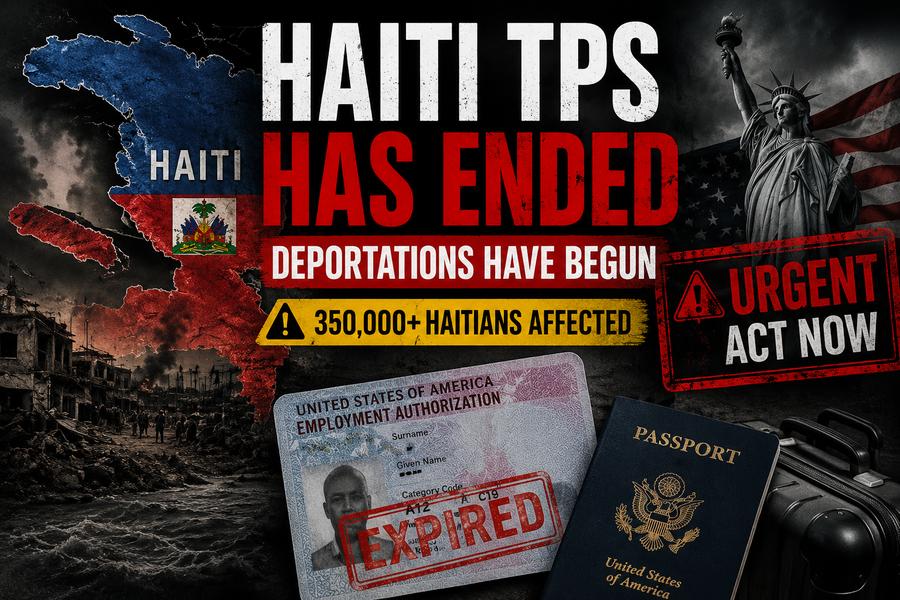
For years, the debate over Temporary Protected Status for Haiti was conducted in the language of dates, court orders, and government notices. That language made the program sound abstract. In July 2026, it stopped being abstract. Haiti's TPS designation ended, and the employment authorization that many beneficiaries had relied on ended with it unless they had another independent basis to work in the United States. The consequences were felt almost immediately in Haitian households, medical offices, nursing facilities, and other workplaces where people protected by TPS had spent years becoming part of ordinary American life.
The legal history is complicated. Haiti first received TPS after the devastating 2010 earthquake. The protection continued through years of natural disasters, political upheaval, and worsening violence. Litigation delayed the most recent attempt to terminate the program, but by late July the protection was no longer keeping hundreds of thousands of Haitians in the same position they had occupied only weeks earlier. In August, deportation flights drew renewed attention to what the termination meant in practice. One flight carrying more than 160 people landed in Cap-Haïtien rather than Port-au-Prince, where security conditions remained extraordinarily dangerous.
The argument over whether TPS should have continued will not be resolved in a single immigration case. For the people who depended on it, however, the immediate question is much narrower: what legal position are they in now? That answer cannot be found on an expired employment authorization card. It requires looking at the person's entire immigration history.
One Haitian woman's story illustrates the problem particularly well
She came to the United States during a period of turmoil in Haiti. She was young, continued her education here, and eventually became a lawyer. She also became the mother of three children. While she was establishing a professional and family life in the United States, the home she had left in Haiti was destroyed in a natural disaster. Her elderly mother remained there with few resources, and her daughter helped support her financially from the United States.
For years, TPS gave her a measure of stability. She could remain in the country under that protection and, while her TPS employment authorization was valid, she could work. The termination of the program changed that calculation abruptly. Without another basis for employment authorization, she could no longer simply continue the professional life she had built as though nothing had happened.
There is another part of her history that now requires careful attention. Her family says it was targeted in Haiti because family members were regarded as political opponents. She had not pursued asylum earlier. TPS was protecting her, she was working, raising children, and building a life, and the urgency of pursuing a separate form of humanitarian relief did not appear to her then as it does now.
She is now considering whether she has a viable protection claim. That does not mean a late asylum application will automatically be accepted. Asylum is generally subject to a one-year filing deadline, with exceptions that depend on the facts and timing of the case. A person who has been in the United States for many years needs a careful analysis of any claimed changed or extraordinary circumstances before assuming an exception applies. Depending on the individual facts, withholding of removal or protection under the Convention Against Torture may also have to be considered — those forms of relief have different legal requirements and are not substitutes that can simply be selected from a menu.
Her experience exposes one of the difficult realities of a temporary protection program that lasts for many years. People do not put their lives on hold while the government repeatedly extends a temporary status. They go to school, work, marry, have children, support relatives, become professionals, and develop roots. TPS does not promise permanent residence, but the human life that develops during years of protection is necessarily more permanent than the label attached to the immigration program.
The effect is being felt in healthcare, not only in immigration offices
The end of Haitian TPS has also produced a problem that is easy to miss if the issue is viewed only through immigration statistics. Haitian workers have become an important part of the healthcare and caregiving workforce, particularly in states such as New York and Florida. Reuters reported in August that about 21,000 Haitian TPS holders worked as caregivers and nursing assistants and served roughly 77,000 patients nationwide. Providers interviewed by Reuters described losing experienced workers from positions that were already difficult to fill.
That broader reporting closely resembles what we are hearing locally. One physician described losing Haitian members of her nursing staff in approximately a week. The employees had not suddenly become less qualified, and their patients had not stopped needing them. Their ability to work had changed because the employment authorization connected to TPS was no longer valid. The physician was left trying to replace trained staff in a healthcare labor market where experienced employees cannot necessarily be found and trained on a few days' notice.
A Brooklyn podiatrist encountered the same problem on a smaller scale. She arrived at her office in late July and found that three Haitian assistants could not return to work after their TPS-based employment authorization ended. The office was immediately short-staffed. Patients who were accustomed to those employees noticed their absence, while the practice had to begin looking for replacements without the luxury of a normal transition or training period.
These examples matter because they show that the consequences of terminating a long-running immigration program do not remain confined to the people whose documents expire. A healthcare worker loses employment, but a doctor also loses an experienced employee and a patient loses a familiar caregiver. A mother loses her work authorization, while the elderly parent she supports abroad loses income. An immigration decision made in Washington can appear days later as an empty desk in a Brooklyn medical office.
Reuters has documented the same strain at larger facilities. One New York nonprofit serving people with disabilities reportedly had to lay off nearly two dozen Haitian employees, amounting to about seven percent of its staff. Families and remaining employees were left trying to fill gaps in care. Whatever one's political view of TPS, the workforce consequences are real and deserve to be discussed as part of the policy rather than as an unrelated side effect.
Returning to Haiti is not a simple proposition
The termination also comes at a time when conditions in Haiti remain deeply troubling. In August, more than 160 deportees arrived on a U.S. flight to Cap-Haïtien. The flight did not use the principal airport in Port-au-Prince because of security concerns. Associated Press reporting at the time described gangs as controlling an estimated 70 percent of the capital and surrounding areas, while millions of Haitians continued to face displacement, poverty, hunger, and violence.
For some former TPS holders, the instruction to "return home" therefore describes a place that no longer exists in the form they remember. Houses were destroyed by earthquakes and other disasters. Families were displaced. Relatives died or moved elsewhere. Neighborhoods changed. Some people protected by TPS have spent a substantial part of their adult lives in the United States.
None of that, standing alone, creates a new immigration status. It does explain why former TPS beneficiaries should not make decisions about departure, asylum, or any other application without first understanding their actual legal position.
TPS ended, but every immigration case did not end with it
The most important legal point is also the easiest to lose in the political discussion. The termination of TPS ends protection provided by TPS. It does not place every former beneficiary into an identical immigration situation.
Some people already have pending asylum applications. Some have pending or approved family petitions. Others may have U.S.-citizen spouses, adult children, or other relatives who could be relevant to a family-based immigration analysis. A person may have facts potentially relevant to VAWA or to a U visa. Someone else may already be in removal proceedings, may have an old removal order, or may have another immigration status or another source of employment authorization.
A pending I-130 deserves particular attention, but it should not be misunderstood. Filing or even obtaining approval of an I-130 does not, by itself, automatically give a person lawful status, a work permit, or protection from removal. Nevertheless, a Haitian former TPS beneficiary with a pending family petition should have the case reviewed now. Depending on the circumstances, counsel can examine whether there is a legitimate basis to seek expedited processing, whether adjustment of status is legally available, whether consular processing would create additional risks, and whether any waivers or other applications are relevant.
The same urgency applies to people with pending asylum cases. A case that has been waiting for years should not be treated as a file that can simply continue collecting dust. Country conditions change, witnesses become available, threats may continue, family members may be harmed, and new documentary evidence may emerge. The evidence supporting the claim should be reviewed and updated. The end of TPS does not make an asylum claim stronger merely because TPS ended; the asylum case still has to satisfy the legal requirements on its own facts.
People who never filed for asylum present a different and often more difficult problem. Some will say they were afraid to return to Haiti but relied on TPS and therefore did not pursue asylum. That history may be relevant, but it does not erase the one-year filing rule automatically. The timing of the fear, the basis for the claim, changes in personal circumstances, changes in Haiti, and the person's immigration history all matter. A late filing should be approached as a legal problem requiring analysis, not as a paperwork solution to the loss of TPS.
Fear should not replace a legal review
We are also hearing from Haitian families who are afraid to leave their homes, worried that an encounter with immigration authorities could result in detention. Recent deportations make that anxiety understandable. But hiding indefinitely is not a legal strategy, and neither is assuming that the end of TPS means that nothing remains to be done.
A useful review starts with the complete record: how and when the person entered the United States; every TPS registration and renewal; any prior asylum filing; immigration-court history; family petitions; marriages and divorces; U.S.-citizen or permanent-resident relatives; criminal or arrest history; prior orders of removal; possible victim-based relief; and any other immigration application filed over the years. Only after that history is assembled can an attorney give meaningful advice about what options may still exist.
For some people, the conclusion may be that there is no presently available path to remain. For others, a family petition, protection claim, or another form of relief may deserve immediate attention. The important point is that those conclusions should come from the law and the individual record, not from panic or from generalized advice circulating on social media.
The American communities affected by the termination also have a role
The disappearance of Haitian workers from medical practices and care facilities has made the TPS debate relevant to people who may never have thought of themselves as participants in an immigration issue. Patients, employers, and families who relied on Haitian nurses, assistants, and caregivers are entitled to tell elected officials what the policy has meant in their communities.
Congress has the authority to change immigration law and to consider legislation providing protection or another path for particular groups. Contacting a member of Congress does not create immigration status for an individual TPS holder, and it should not be presented as a substitute for legal representation. It is, however, entirely legitimate for constituents to ask their representatives to address a policy that they believe is harming their communities, employers, or healthcare system.
For Haitian families, the immediate task is more personal. If there is a pending I-130, find out exactly where it stands and what it can and cannot accomplish. If there is a pending asylum case, review the evidence rather than waiting passively for the next hearing or interview. If persecution was never raised because TPS seemed sufficient at the time, obtain advice about the filing deadline and any other forms of protection before submitting a new application. If there is an old removal case, do not assume it disappeared simply because TPS provided protection for years.
TPS was temporary. The lives built during TPS were not.
That may ultimately be the central difficulty in the Haitian TPS story. The law always described the protection as temporary, but many of the people protected by it spent years becoming part of American workplaces, families, and communities. The government can terminate an immigration designation on a particular date. The relationships, careers, and responsibilities formed during those years do not disappear on the same date.
For the young lawyer raising three children, the question is now whether another form of protection is legally available. For the Brooklyn podiatrist, the problem is how to run a medical office after losing three experienced assistants. For patients and families, it may be the sudden absence of the person who had cared for them. Each is experiencing a different consequence of the same policy.
Former Haitian TPS beneficiaries should resist two equally dangerous assumptions: that TPS termination automatically means immediate departure in every case, or that years spent in the United States automatically create a right to remain. Neither is correct. What matters now is the person's actual immigration history and whether the law provides another avenue of relief.
For people who have relied on TPS for years, that review should not be postponed until an employment problem, arrest, or removal proceeding forces the issue. The protection that once allowed the case to remain in the background is gone. Whatever other legal options exist need to be identified on their own merits.