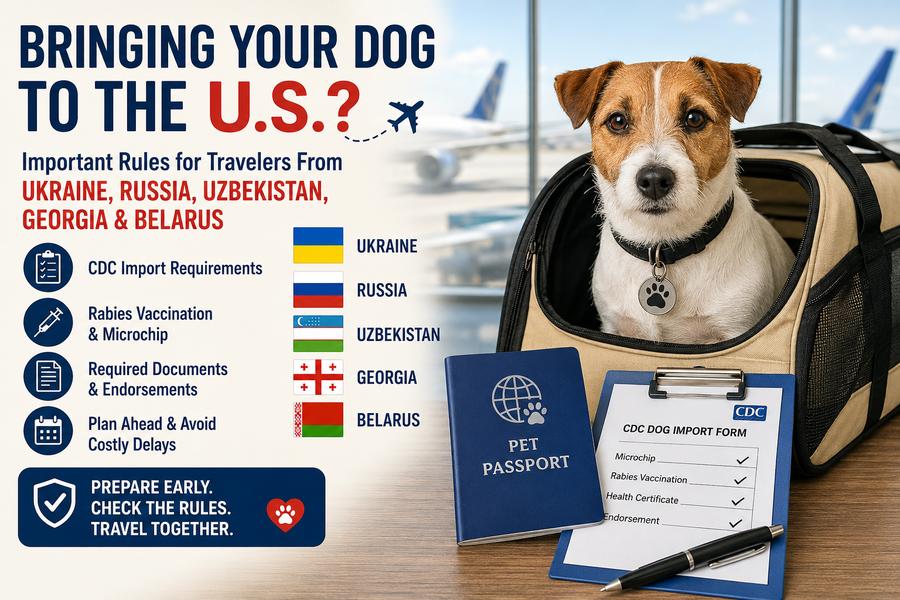
You received your U.S. visa. Your airline tickets are booked. Your bags are packed. And your dog or cat — the pet that has been part of your family for years — is coming to America with you.
Then, at the airport, you discover there is a problem. A vaccination certificate is not sufficient. A required government endorsement is missing. The microchip information does not match. Your dog does not have the necessary rabies documentation. Or you discover that your dog cannot simply arrive at the U.S. airport printed on your ticket. Suddenly, a family trip or permanent move to the United States can become a crisis.
For people traveling with pets from Ukraine, Russia, Uzbekistan, Georgia, and Belarus, preparation is particularly important because, as of 2026, all five countries are on the CDC's list of countries considered high-risk for dog rabies — and that can significantly change what's required to bring a dog into the United States.
Your dog's country of travel history matters
One of the most important things travelers need to understand is that U.S. authorities do not necessarily look only at the country from which your flight departs. The CDC considers where the dog has been during the six months before entering the United States. If a dog has been in any country classified by the CDC as high-risk for dog rabies during those six months, the more stringent high-risk-country requirements can apply.
As of 2026, the CDC high-risk list specifically includes Ukraine, Russia, Belarus, Georgia, and Uzbekistan. This distinction is extremely important: flying through another country does not necessarily erase your dog's previous six-month travel history.
The basic rules for every dog entering the United States
Since August 1, 2024, every dog entering the United States must satisfy several basic CDC requirements. The dog must:
- Appear healthy when arriving in the United States
- Be at least six months old
- Have a microchip
- Travel with a receipt showing submission of the CDC Dog Import Form
But these are only the basic requirements. For a dog that has been in Ukraine, Russia, Belarus, Georgia, or Uzbekistan during the preceding six months, additional rules apply because these countries are currently classified as high-risk — and this is where travelers can get into serious trouble.
A foreign-vaccinated dog from these countries requires much more preparation
Suppose a family in Kyiv, Tbilisi, Minsk, Moscow, or Tashkent is moving to the United States and their dog was vaccinated locally. A standard vaccination booklet alone is not enough to satisfy the current CDC requirements for a foreign-vaccinated dog coming from a high-risk country.
The CDC currently requires a Certification of Foreign Rabies Vaccination and Microchip form. A veterinarian completes the form, but it must also be endorsed by an official government veterinarian in the exporting country. The dog must have a valid rabies vaccination, and the microchip and vaccination history must satisfy CDC requirements. The certification generally must be completed no more than 30 days before travel — very different from simply putting your vaccination booklet in your carry-on luggage.
The rabies titer can be extremely important
Foreign-vaccinated dogs from high-risk countries can also require a valid rabies serology titer from a CDC-approved laboratory. This blood test demonstrates an adequate immune response to the rabies vaccination.
If the dog does not have an acceptable titer, the consequences can become much more complicated. CDC states that foreign-vaccinated dogs from high-risk countries must have a reservation at a CDC-registered animal care facility. Without a valid rabies serology titer, that reservation must include a 28-day quarantine — transforming what seemed like a simple international flight with a pet into a complicated and potentially expensive process.
You may not be able to fly into any U.S. airport you want
This is another requirement that can surprise travelers. Foreign-vaccinated dogs that have been in a high-risk country during the preceding six months must have a reservation at a CDC-registered animal care facility and must arrive by air at the U.S. airport associated with that facility. Simply finding an airline willing to transport your dog is not necessarily enough — your U.S. arrival airport matters too. A family may discover that the most convenient flight to their final destination does not satisfy the dog's entry requirements. This is something that should be investigated before purchasing nonrefundable tickets.
A realistic scenario: everything is packed, but the dog cannot fly
Imagine a family leaving Ukraine for the United States. They have waited months for their immigration documents. They sell some belongings, terminate their apartment lease, and purchase airline tickets. Their dog has been vaccinated against rabies, so they assume everything is fine.
Two days before departure, they learn that their ordinary vaccination certificate is not enough. Their dog needs the appropriate CDC certification completed by a veterinarian and endorsed by an official government veterinarian. Then they discover another problem: the dog needs additional arrangements involving a CDC-registered animal care facility in the United States. Their flight is already booked. Their apartment is gone. Their U.S. relatives are waiting. But their dog may not be able to travel as planned.
This is a hypothetical example used to illustrate exactly the type of situation careful advance preparation is intended to prevent.
A story from our own practice: the return trip is a separate problem
Recently, we met with a visitor from Russia traveling on a B-1/B-2 visa. Her trip involved several connecting flights, and some of the layover countries were themselves designated as high-risk for dog rabies. That distinction matters, because these classifications change, and only the current, updated list should be relied on before a trip — not the list a friend or travel agent checked months earlier.
When she landed in New York, she was told her dog would need additional mandatory vaccinations before it would be allowed to travel again on her return flight home. This came as a genuine shock. Without pet insurance and without a timely veterinary appointment already arranged, the situation created real stress — and in a worst-case scenario, complications like this can even put a traveler's own immigration timeline at risk if they're forced to overstay while sorting it out.
In many states, getting a veterinary appointment isn't simple unless it's a true emergency. Not every clinic accepts walk-ins, and appointments often need to be arranged well in advance. When you do get in, expect to be asked about the animal's age, breed, country of origin, and full vaccination history.
Certified translation of foreign pet documents
If your dog's vaccination records, veterinary certifications, or government endorsements were issued in your home country, you should be prepared to have them translated by a certified translator.
For less common languages — including Georgian, Uzbek, and Tajik — do not rely on Google Translate or a similar tool. Use an official, recognized certified interpreter. We recommend notarized certified translations for any document connected to your pet's entry, including documentation for a therapy or emotional support animal.
Airline and airport practicalities
Beyond CDC and USDA rules, airlines have their own requirements, and airports vary in what they offer:
- Some airports now have designated pet relief areas, but you should confirm this before your trip rather than assume
- Pack extra dog food in case of flight delays or missed connections
- For a puppy or an elderly dog, consider bringing a high-calorie nutritional gel in case a longer-than-expected travel day affects the animal's appetite or energy
- Bring any of your dog's medications, along with a written description of what each one is for
Fraud, misrepresentation, and aggressive animals can affect admission
Any misrepresentation or fraud connected to your pet's documentation can itself be a ground for denial of admission — not just a problem for the animal. Accuracy in every form and certificate matters as much as the underlying vaccination history.
The animal also should not pose a danger to the public. Avoid traveling with an animal that has shown aggressive behavior, and be prepared for officers to evaluate this on arrival.
Therapy and emotional support animals need proper documentation too
If you have a note from a psychiatrist or therapist explaining that your dog is a therapy animal, that documentation must be properly prepared and, if issued abroad, properly translated. As with other pet-related paperwork, we recommend notarized certified translations. Similar documentation expectations apply to other types of pets beyond dogs.
What officers typically ask
Based on what we see with clients, expect questions along these lines at arrival:
- Is the country your pet is traveling from considered high-risk?
- What is the age of the animal?
- What type of animal is it?
- What is the animal's health evaluation from a veterinarian, and when was it performed?
- What vaccines has the animal completed?
A serious legal note: there was a period some years ago when animals were used to help transport illicit substances. Be aware that feeding an animal drugs, or attempting to use a pet to traffic illicit substances, is illegal. Current immigration enforcement takes all criminal conduct seriously, and each state has its own statutes protecting the public. Prepare for your travels, and travel safely.
What happens if the dog does not meet the requirements?
This is not merely paperwork that travelers can assume will be corrected after arrival. CDC states clearly that travelers must follow the dog-importation requirements or the dog will not be allowed to enter the United States. For someone permanently relocating to America, that possibility can be devastating — the pet may have been with the family for ten years, and children may have grown up with the animal.
Human immigration permission and animal-importation permission are two completely different matters. Being legally admitted to the United States does not automatically mean your pet can enter with you.
What about a dog that was originally vaccinated in the United States?
There is an important distinction for people who traveled from America with their dogs and are now returning. If a dog received its rabies vaccination in the United States and subsequently traveled to one of these high-risk countries, different documentation applies.
As of 2026, CDC requires a U.S.-vaccinated dog returning after travel to a high-risk country to have the CDC Dog Import Form receipt and the specific Certification of U.S.-Issued Rabies Vaccination form. This is not simply the ordinary rabies certificate your veterinarian may have given you — it's a specific CDC form. The form must be completed by a USDA-accredited veterinarian before the dog leaves the United States and endorsed by USDA. CDC states that it cannot simply be issued retroactively after the traveler discovers the requirement overseas.
This is extremely important for Americans planning to take their dogs to Ukraine, Georgia, Uzbekistan, Belarus, Russia, or another high-risk country and then return home. Prepare for the return trip before leaving the United States.
Cats are different
The federal CDC requirements for cats are significantly less complicated. CDC requires cats entering the United States to appear healthy upon arrival. Cats may be inspected at the port of entry, and if a cat appears ill or shows evidence of a disease transmissible to humans, authorities may require further veterinary examination at the owner's expense.
Unlike dogs, CDC does not currently require proof of rabies vaccination for cats entering the United States. However, CDC recommends rabies vaccination, and the state or territory where you are traveling may impose additional requirements — Hawaii and Guam, for example, have their own special animal-entry and quarantine requirements. Don't assume that "CDC doesn't require it" means there are no other rules.
CDC is not the only agency that matters
Another common mistake is checking one government website and assuming the research is finished. CDC is the primary federal authority governing dog imports, but USDA APHIS may impose additional animal-health requirements, and your destination state can also have its own rules.
The airline is another layer entirely. An airline may have its own policies regarding approved carriers, pet size and weight, cabin versus cargo transportation, temperature restrictions, breed restrictions, health certificates, advance reservations, and the number of animals permitted on a particular flight. Meeting U.S. government requirements does not automatically guarantee that an airline will transport the animal.
Don't rely on what worked several years ago. Someone may tell you, "I brought my dog to America five years ago. I just showed the vaccination certificate." That person's experience may be completely irrelevant to your trip in 2026. The current CDC dog-importation framework took effect in August 2024, and CDC continues to maintain updated forms, instructions, and country classifications. Always check the rules that apply at the time you are traveling.
A family member is not luggage
For many immigrants, a dog or cat is not simply an animal they happen to own — it's part of the family. For someone leaving a country during war, political instability, or a major life transition, that animal may represent one of the few pieces of home coming with them. Imagine telling your child at the airport, "We can go to America, but the dog can't come with us." That is not a conversation any family wants to have — and in many cases, the crisis may be avoidable if the requirements are investigated early enough.
Before you buy the ticket: a practical checklist
- Where has your dog been during the previous six months?
- Is the dog at least six months old?
- Does the dog have an acceptable microchip?
- Does the rabies vaccination satisfy CDC requirements?
- Do you need the Certification of Foreign Rabies Vaccination and Microchip?
- Does the document have the required government endorsement?
- Is a rabies serology titer required, and is it acceptable?
- Do you have a CDC-registered animal care facility reservation, if needed?
- Is your U.S. arrival airport permitted for your situation?
- Have you completed the CDC Dog Import Form?
- Have you checked your airline's separate pet-transportation requirements?
- Have you checked USDA and destination-state requirements?
The exact requirements depend on the dog's vaccination history and travel history, so travelers should use CDC's official Dog Importation Navigator rather than relying solely on a general checklist.
Do not wait until the week before departure
Some immigration preparations can be completed relatively quickly. International pet transportation may not be one of them. Veterinary appointments, rabies vaccination timing, microchip requirements, government endorsements, laboratory testing, and reservations can require advance planning. For example, CDC states that if a foreign-vaccinated dog from a high-risk country is receiving its first rabies vaccination, the vaccine must generally have been administered at least 28 days before the dog enters the United States. That is something you cannot fix while standing at the airport.
Moving to America means preparing the entire family
People relocating from Ukraine, Russia, Belarus, Georgia, or Uzbekistan naturally focus on their own immigration documents: visa, passport, asylum documentation, green card, employment authorization, airline ticket. But if your dog or cat is coming with you, your pet has an entirely separate set of entry requirements. Do not assume that because you are permitted to enter the United States, your pet automatically is too. Prepare early, check the current rules, and make sure that when your family arrives in America, the entire family arrives together.
CDC — Bringing a Dog Into the United States
CDC — High-Risk Countries for Dog Rabies
CDC — Foreign-Vaccinated Dogs From High-Risk Countries
USDA APHIS — Bringing a Pet Dog Into the United States