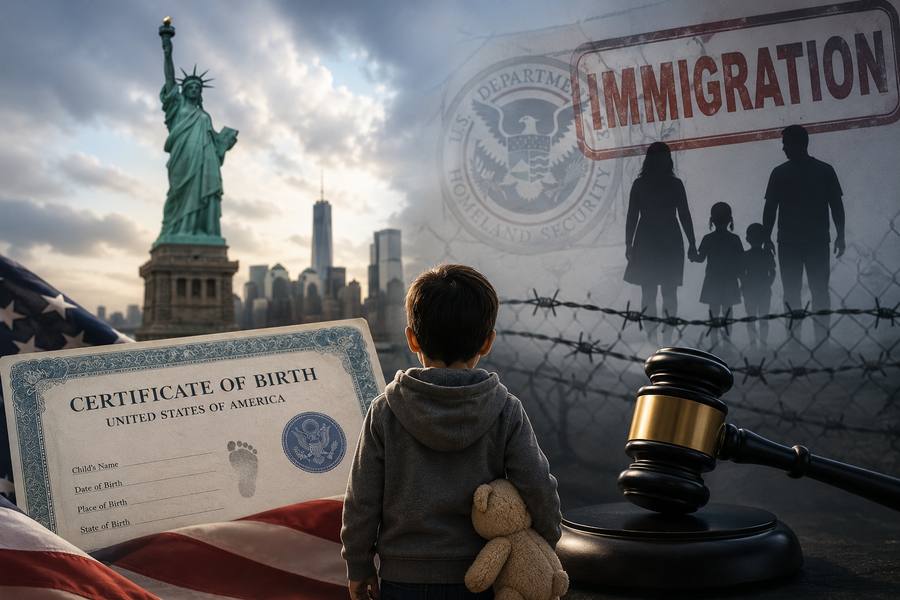
For generations, one principle of American immigration law seemed almost untouchable: a child born in the United States is a United States citizen. For immigrant parents, that certainty often remained even when their own immigration cases were complicated, delayed, or uncertain.
But a new executive order signed by President Donald Trump on August 6, 2026 is attempting to create additional categories of children whom the federal government would not recognize as U.S. citizens at birth. The implications could be enormous.
The order specifically targets situations involving a parent connected to a designated terrorist organization, certain foreign-government employees, and alleged schemes or fraud connected with obtaining birthright citizenship. That raises a frightening question for immigrant families: could something buried in a parent's immigration history years ago eventually create a problem for a child who was born in America and has always believed he or she was an American citizen?
The answer requires an important legal qualification. The Supreme Court ruled on June 30, 2026 that children born in the United States to parents who were unlawfully or temporarily present are citizens at birth under the Fourteenth Amendment. That remains an extraordinarily important constitutional protection. At the same time, the administration is now attempting to define additional exceptions — and that conflict is likely to produce more litigation. For families whose histories may fall anywhere near these new categories, waiting to find out what happens may be dangerous.
What did President Trump's new executive order do?
Executive Order 14418, titled "Continuing to Protect the Meaning and Value of American Citizenship," was signed on August 6, 2026. The order directs federal agencies not to recognize U.S. citizenship in certain cases where neither parent is a U.S. citizen and one of several additional conditions exists, including situations where:
- A parent is considered an "alien enemy," including a member of a designated Foreign Terrorist Organization or certain specially designated terrorists
- A parent is employed in an official capacity by a foreign government, embassy, consulate, or qualifying international organization
- A parent allegedly participated in fraud or a commercial arrangement intended to obtain U.S. birthright citizenship
- Certain births occur in U.S. territories where citizenship is not otherwise provided by federal law
The order also directs the Department of Homeland Security, Department of Justice, Department of State, and Social Security Administration to take steps toward implementation and requires agencies to issue guidance. That is why immigrant families should pay attention now — not months or years from now.
This does NOT mean every U.S.-born child is losing citizenship
It is critical not to exaggerate what has happened. The Supreme Court has already ruled that children born in the United States to parents who are unlawfully present or here temporarily are protected by the Citizenship Clause of the Fourteenth Amendment. The Court stated that such children satisfy the constitutional requirements for citizenship at birth.
The new executive order is attempting to identify narrower categories that the administration argues fall outside that rule. Those categories will almost certainly raise major constitutional questions. So this is not a situation where millions of Americans suddenly lose citizenship overnight. But for some families, the new order may cause questions they never imagined they'd have to answer.
Example: a ten-year asylum case and three U.S.-born children
A husband and wife arrive in the United States and apply for asylum. Their case does not move quickly — years pass because of the enormous immigration court backlog. One year becomes three. Three becomes six. Eventually, nearly ten years have passed. During that time, the couple builds a life in America: they work, they rent a home, and they have three children born in the United States. Those children grow up as Americans, attend American schools, and receive U.S. birth certificates and passports. Their parents' asylum case, however, remains unresolved.
Finally, after approximately a decade, the parents receive their final immigration hearings. One spouse succeeds and receives asylum. The other does not — the government alleges that this parent was previously connected to a political organization in the family's home country. When the parent originally participated in that organization years earlier, the political situation was completely different. But organizations change, governments change, and U.S. terrorist designations can change. Now imagine that the organization later appears on a U.S. list of designated terrorist organizations. Suddenly, what once looked like an old political association becomes a potential national-security issue.
Under the administration's new executive order, parental membership in a designated Foreign Terrorist Organization is specifically identified as a circumstance that could affect the federal government's recognition of birthright citizenship when neither parent was a U.S. citizen at the relevant time. Now the family has a terrifying question: could the government attempt to question the citizenship documentation of the three children because of an allegation involving one parent? The children did nothing wrong — yet the parent's immigration file may suddenly matter in ways the family never expected.
This is a hypothetical example used to illustrate concerns many immigrant families may face.
A critical distinction: birthright citizenship is not the same as naturalization
You may hear the word "denaturalization" used in discussions surrounding these policies. Legally, however, there is an important distinction. Naturalization is the process by which someone who was not a citizen at birth later becomes a U.S. citizen. A U.S.-born child who acquired citizenship automatically under the Fourteenth Amendment was not naturalized. Therefore, traditional denaturalization laws are not the ordinary mechanism used against a person who was a citizen from birth.
The Justice Department is currently pursuing significantly more traditional denaturalization cases against naturalized citizens accused of obtaining citizenship through fraud, concealed terrorist support, war crimes, or other serious misconduct. In May 2026, for example, DOJ announced civil denaturalization actions against 12 individuals, including cases alleging concealed terrorist support. That is legally different from attempting to deny or withdraw recognition of birthright citizenship — but from the perspective of an immigrant family, the practical fear may feel very similar: "could the government suddenly tell my child that the citizenship we relied upon for years is being questioned?" That possibility alone is reason enough to take these developments seriously.
Example: a tourist visa, 25 years in America, and an old visa application
A woman arrives in the United States on a B-1/B-2 visitor visa and remains in the country. Years pass, and eventually she has children born in the United States; the father does not have lawful immigration status. The children grow up believing, as virtually every family in this situation historically has, that their U.S. birth makes them American citizens.
Twenty-five years later, her life looks completely different. She has built a family and community in America, later marries a U.S. citizen, and files a family-based immigration petition. Because of delays, the process takes years. Eventually, USCIS schedules an interview — and an old document surfaces. When she originally applied for her tourist visa decades earlier, she stated that she was married. Immigration authorities now question whether that supposed spouse ever existed, and allege that the statement was a material misrepresentation made to obtain the visa.
That allegation could create serious problems in her own adjustment-of-status application. But under the administration's evolving approach to birthright citizenship, another question could potentially arise: was there fraud connected with the circumstances that ultimately resulted in the child's U.S. birth? The executive order does not say that any mistake on an old visa application automatically jeopardizes a child's citizenship — but it dramatically increases the importance of understanding exactly what was written in old immigration filings, and why.
This is a hypothetical example used to illustrate concerns many immigrant families may face.
What if the parent worked for a foreign government?
Now add another fact: before arriving in the United States, the same woman worked for the government of her home country, and even after coming to America she occasionally completed independent projects connected to that government. Until recently, the family may never have imagined this employment history could have anything to do with the citizenship of a U.S.-born child.
The August 2026 order expressly includes certain foreign-government employees — including people employed by a foreign government in an official capacity — among the categories the administration seeks to treat differently for birthright citizenship purposes. Traditional constitutional law already recognizes a narrow exception involving children of foreign diplomats because of their unique legal relationship to U.S. jurisdiction. The new order goes further by attempting to identify additional foreign-government employment relationships, which is one reason the policy is likely to face further constitutional challenges.
The Supreme Court already protected birthright citizenship — so why be concerned?
Because the legal fight is not over. In Trump v. Barbara, the Supreme Court held that children born in the United States to parents who are unlawfully or temporarily present are citizens at birth, and the majority reaffirmed that the Fourteenth Amendment's Citizenship Clause protects those children.
But the August executive order relies on language in that same decision concerning special situations where an "extraterritorial fiction" applies, and attempts to define additional categories outside ordinary birthright citizenship. Whether all of those categories survive judicial review is another question entirely. Families should understand both realities: birthright citizenship remains constitutionally protected, and the federal government is actively testing how far the exceptions to that protection can be expanded.
Why old immigration records matter more than ever: old visa applications, asylum statements, political-organization membership, government employment, military service, prior marriages, statements made at a U.S. consulate, and addresses on old forms can all become significant when USCIS, ICE, the State Department, or DOJ reviews a case years later. Your immigration history does not disappear just because decades have passed.
Could a parent's mistake really affect a child?
Under longstanding constitutional doctrine, a U.S.-born child's citizenship does not simply disappear because a parent committed an immigration violation. That protection remains enormously significant. But the August 2026 executive order is specifically attempting to connect certain parental conduct and status to whether the federal government recognizes citizenship at birth — which is why these cases are so concerning.
A child may have never committed immigration fraud, never belonged to a political organization, never worked for a foreign government, and never chosen the circumstances of a parent's entry into the United States. Yet the administration's policy may require agencies to examine the parent's circumstances when determining citizenship recognition in the targeted categories. That is an extraordinary development.
Don't panic — but don't ignore this either. Fear alone is not an immigration strategy, and families should not assume an executive order automatically eliminates citizenship the Constitution protects. But ignoring these developments would be equally dangerous. If your family's immigration history includes complicated facts — asylum proceedings, old visa applications, allegations of misrepresentation, political-party membership, organizations that may now appear on terrorism-related lists, or foreign-government employment — now may be the time to review them before the government does.
What should families do now?
- Obtain copies of old applications and prior visa filings
- Review asylum statements and identify political or organizational affiliations that were disclosed
- Document any foreign-government employment
- Compare old filings with later immigration applications for discrepancies
- Discuss questionable issues with an experienced immigration attorney before submitting new forms or attending an interview
An attorney may also recommend obtaining your immigration records through appropriate government record requests, so you know what the government already has in its files.
The government is looking backward. You should too.
Immigration enforcement is increasingly focused not only on a person's present circumstances but on what happened years, or decades, earlier. Something written on a tourist visa application in the 1990s can potentially affect an adjustment-of-status application today. An old political affiliation may suddenly receive new scrutiny. Foreign-government employment that once seemed irrelevant may now receive greater attention. The worst time to discover an immigration problem is during a USCIS interview, after receiving a Notice to Appear, or after the government challenges a document. A problem discovered early may allow time to collect evidence, investigate the underlying facts, and build a legal strategy.